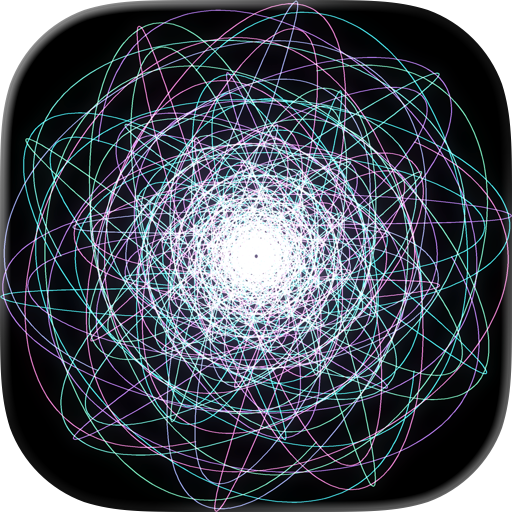
200 straight lines on a circle. No curves drawn anywhere. Yet a curve appears — from the density of the chords. Drag to change the multiplier. Watch the cardioid bloom.
Times Circle Weave draws only straight lines. The curves you see are not drawn — they emerge.
Place 200 equally spaced points around a circle. Connect each point to the point at its index times M, wrapping around the circle when the result exceeds 200. Draw all 200 lines simultaneously. Where many lines cluster together, the canvas brightens from their accumulation. The bright region is not a line. It is the envelope — the curve that all 200 straight lines are simultaneously tangent to. The curve exists only as a mathematical consequence of the lines. It is never drawn directly.
At M equals two, the envelope is a cardioid. The heart shape appears in pure geometry: one inward cusp, one smooth rounded arc, the exact shape traced by a point on a circle rolling around another circle of the same size. This is why cardioids appear at the bottom of coffee cups in sunlight, in certain microphone pickup patterns, and as the boundary of the main bulb of the Mandelbrot set. The times-two multiplication circle produces all of them at once.
At M equals three, a nephroid — two cusps, kidney-shaped, the caustic of light reflected inside a hollow sphere. At M equals four, a three-cusped deltoid. At M equals five, the four-pointed astroid. Each integer multiplier produces one of the named epicycloids, each with one more cusp than the last. Between the integers, the envelope takes unnamed intermediate forms — partial cusps, asymmetric lobes, transient shapes with no label in any textbook.
This is what the game asks you to find.
A dim gold overlay shows the target: the chord pattern at a specific multiplier. A single horizontal drag changes M. Moving right increases it. Moving left decreases it. The 200 chord lines pivot live as M shifts. The envelope morphs — cardioid becomes nephroid becomes deltoid in a continuous transformation. When the current pattern matches the gold target, the chords flash gold simultaneously and the puzzle locks.
Early levels specify integer multipliers. The cardioid is one cusp. The nephroid is two. Count the cusps, find the integer. Later levels specify fractional multipliers — M equals two and a half sits between cardioid and nephroid, its pattern distinctly three-fold but unnamed. The final levels give no hint at all. The target pattern glows gold and the player must read the shape: how many lobes, how many cusps, what is the symmetry. M is the answer. The pattern is the question.
The relationship between multiplier and curve is precise: M minus one equals the number of cusps. This is not an approximation. It is an exact theorem. Players discover it without being told — they count cusps, notice the pattern, and begin predicting. This is what learning mathematics actually feels like.
No curves drawn. No equations shown. Just 200 straight lines, one multiplier, and the shapes waiting inside their intersections.
Chrome-Stats does not own this Apple app. Please use these information below to contact the Apple app developer.

 English
 Español
 Français
 Português
 日本語
日本語 简体中文
简体中文 한국인
한국인


 (0)
(0)