Bricks, Balls & Paddle Game
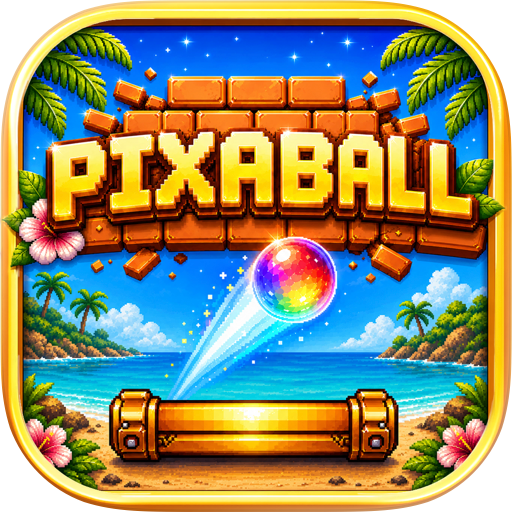
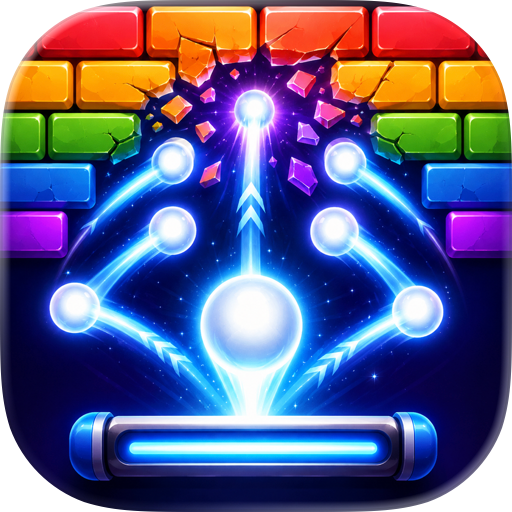
One paddle. One ball. A wall of pixel bricks that shatters a little more with every bounce. Then one ball becomes three hundred, and the whole board comes apart.
One paddle. One ball. A wall of pixel bricks that loses a little more of itself with every bounce.
Then one ball becomes three. Then nine. Then three hundred — and a board you were carefully picking apart a moment ago vanishes in a roar of light.
BrickPong is a brick breaker built around a single idea: hundreds of balls on screen at once, at a steady 60 frames per second, on a phone.
THE STORM
Most boards open the same quiet way — you, a paddle, and more bricks than you want to count. Then the board starts multiplying what you have. One ball splits into three. Those three split again. The escalation is exponential and it is fast: a board you were losing can turn into a screen-filling avalanche in under two seconds, and the biggest ones carry well over a thousand bricks that a full storm will eat alive.
Up to 320 balls can be in play at once. You will not be steering them. That is the point.
DRAWN BY HAND, ONE BOARD AT A TIME
Every board in the game is hand-designed pixel art. Not a generator, not a template — someone placed those bricks. The game opens with short boards that each teach one idea, then climbs through easy, standard and hard.
The difficulty ramps on spectacle, not precision. Your paddle is exactly as wide on the last board as it is on the first, and the ball travels at exactly the same speed throughout. What grows is the size of the board, the intricacy of the layout and how much chaos it can produce. Later boards are not more punishing. They are bigger, denser and a great deal louder.
STEEL THAT SHAPES THE BOARD
Almost from the start, boards carry unbreakable steel. It never scores, and it is still standing when you finish. It is structure: funnels that pour balls into a pocket, spines that split the board in two, gates that open from one side only, bumpers that turn a dead trajectory into a live one.
Reading the steel is most of the skill here. The bricks are the target — the steel decides whether you can reach them.
TWO WAYS TO THREE STARS
Every board rates you out of three, by whichever of two routes goes better:
• Keep your lives. Lose none of them and it is three stars.
• Or build the storm. Get fifty balls going at once and it is three stars, however many lives it cost you.
The second route exists because the first one punished the exact play the game is built to produce. A screen full of balls cannot be shepherded. If you want to gamble the whole board on one enormous cascade, the game will pay you for it.
CONTROLS THAT STAY OUT OF THE WAY
The paddle tracks how far your finger moves, not where it is, so you can drag from anywhere comfortable and your thumb never covers the thing you are aiming with.
The rebound angle comes from where the ball lands: dead centre sends it near-vertical, the outer edges send it wide. A quiet guard keeps any ball from settling into a flat, unrecoverable loop, so a bad bounce is never a lost board.
Portrait, one hand, any time.
MADE OUT OF CODE
Every in-game asset — the artwork, the sound effects and the music — is generated procedurally from code. There are no imported art or audio files anywhere in the game. The result is a look and a soundtrack that belong to this app and to nothing else.
BUILT TO BE PLAYED BY EVERYONE
Full VoiceOver support, with every counter and every level card spoken aloud. Reduce Motion is honoured from the system setting or an in-app switch, and stops screen shake, particle bursts, orb pulsing and animated backgrounds. Dynamic Type throughout, with menus that scroll rather than clip. Touch targets of at least 44 points. Nothing important is ever communicated by colour alone.
Break the bricks. Then break a great many more of them than you meant to.
Chrome-Stats does not own this Apple app. Please use these information below to contact the Apple app developer.

 English
 Español
 Français
 Português
 日本語
日本語 简体中文
简体中文 한국인
한국인


 (19)
(19)