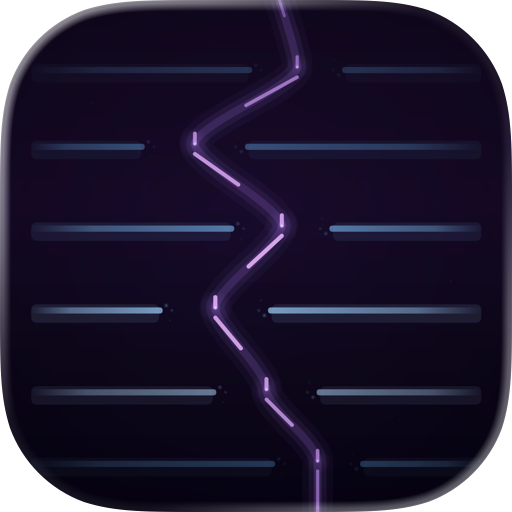
Seven layers between the exosphere and whatever is under the world, both ranked on Game Center.
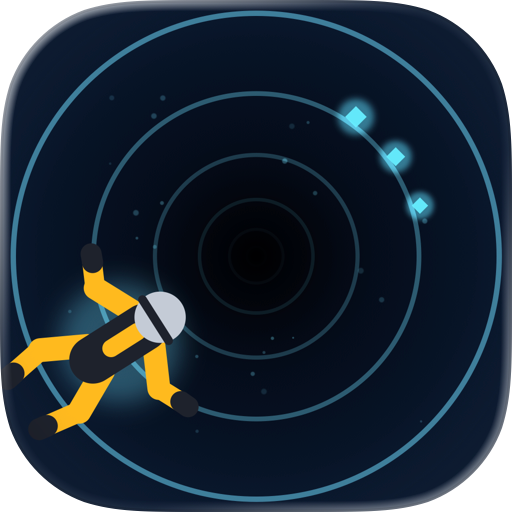
You are a skydiver falling down a vertical shaft. Slide or point a finger and you swing around the inside of it, past the rocks bolted to the wall and through the clouds hanging across the middle. Seven layers down, and then it starts again deeper.
TWO WAYS DOWN
Descent is levelled and keeps going. Three impacts end the run, and every level below the last one is faster and busier. Freefall is ninety seconds flat: an impact costs score and streak but never time, so every run is the same length and the scores actually compare.
SEVEN LAYERS
Exosphere, aurora, stratosphere, skyline, cavern, magma, and the datacore under all of it. One layer per level, top to bottom, so how far you have got is something you can see instead of reading off the HUD. Each layer brings its own hazards, its own light and its own sound. Freefall has no levels, so it tours the whole ladder against the clock.
THE STEERING
The camera sits on the shaft axis and never rotates, so you orbit the middle of the screen and can see which part of the wall you are on. Put your finger where you want to be, or slide left and right from wherever your thumb is resting. The diver has weight, so it takes a moment to start turning and a moment to stop.
WHAT SCORES
Lumens are the common pickup and build a streak multiplier. Prisms are worth ten of them and fade within seconds. Halo Rings only count through the middle. A late dodge scores more than a Lumen, which is why cutting it fine beats playing safe.
NOT EVERYTHING HURTS
Cloud banks slow you and blind you. Balloons shove you off your line. Null zones invert your steering. Five power-ups go the other way: a parachute that drops your speed and doubles your score, goggles that thin the traffic, an aegis that eats one impact, an updraft that pulls Lumens to you, and a slipstream that halves the world's speed without halving your steering.
A SURVIVABLE GAP, ALWAYS
Hazards arrive as composed waves rather than random scatter, and every wave is measured before you see it. If its widest gap is too tight for the speed you will meet it at, it is thrown away and generated again, and the gap it has to leave widens as you get faster. Dying should be your fault.
GENERATED, NOT DRAWN
There is not one image or audio file in the app. Every mesh, texture and sound is built in code at launch, from a seed, which is also why a given level is the same fall for everyone who plays it.
- Game Center leaderboards for depth, level reached and Freefall score, plus achievements for the layers you find and the levels you clear without a scratch
- A field guide that fills in as you meet each hazard, carrying the same note the game shows you mid-fall
- Reduce motion, high-contrast hazards, inverted steering, sensitivity
- Mixes with whatever you are already listening to and never interrupts it
- Plays with no network at all
- Free, with one rewarded video in it: an extra life, offered once per Descent run and not in your first few, with the score it costs printed on the button. No banners, nothing unskippable
- iPhone, portrait, one hand
Chrome-Stats does not own this Apple app. Please use these information below to contact the Apple app developer.

 English
 Español
 Français
 Português
 日本語
日本語 简体中文
简体中文 한국인
한국인

 (0)
(0)