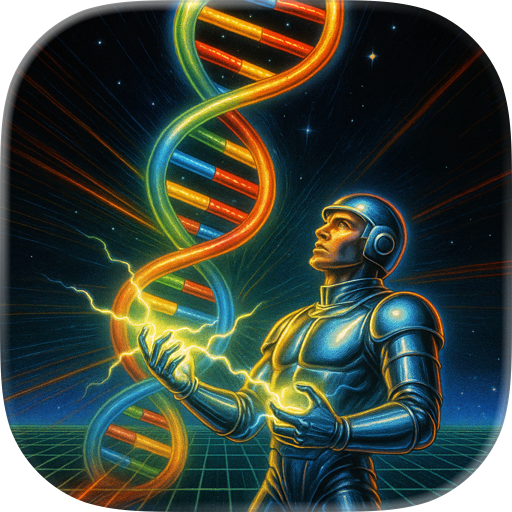
Two DNA sequences. One has a mutation. Find it. A single changed letter causes sickle cell disease. A single deleted letter destroys a cancer repair gene. Solve the case.
Gene Letter Action gives you a patient's DNA sequence and asks you to find what is wrong with it.
Two rows of coloured letters appear side by side. The top row is the reference — a healthy copy of the gene. The bottom row is the patient's sequence. They look almost identical. Somewhere in these eighteen letters, something has changed. One base has been swapped. Or one base has been removed, shifting every letter that follows it. The player scans both rows, looking for the position where the colours stop matching, and taps it.
Finding the mutation is only the beginning. When the correct position is tapped, the affected codon appears — three letters from the reference, three letters from the patient, and the amino acid each set of three codes for. This is the moment the game connects the letter to its consequence. In case one, the reference reads GAG and the patient reads GTG. GAG codes for glutamic acid, a charged amino acid that dissolves in water. GTG codes for valine, a hydrophobic amino acid that repels it. The difference between those two properties, at that one position in the haemoglobin protein, is the molecular cause of sickle cell disease. Under low oxygen, the valine residues cause haemoglobin chains to stick together, deforming red blood cells into rigid crescents that block blood vessels. A single changed letter. A lifetime of painful crises.
Four mutation types across four cases. The first is a missense substitution — one amino acid changed for another. The second is a nonsense substitution — the changed codon becomes a stop signal, halting protein synthesis at position three. The patient produces almost no functional protein. The third is a synonymous substitution — the changed codon still codes for the same amino acid, because the genetic code has redundancy built into it. Sixty-four possible codons, twenty amino acids, and multiple codons mapping to the same one. The patient has no disease. The variant is benign. Not every mutation is dangerous, and understanding why requires knowing how the code works.
The fourth case shows a deletion. One letter is removed from the patient sequence, marked with a gap symbol. Everything after that gap shifts. Every codon from that point is read differently. The protein the cell builds from this sequence is unrecognisable past position ten. This is a frameshift — the most common mechanism behind the BRCA1 variants associated with hereditary breast cancer. The deletion is one letter. The protein is destroyed. The cancer risk is significantly elevated.
After identifying each mutation, a prediction question connects the molecular finding to the patient's clinical presentation. This question is always answerable from what the game has just shown. It is not a memory test. It is a comprehension test — the player who understood the codon change can answer what it does to the patient.
By the final case, the player can read a clinical genetics report notation like c.68delA or p.Glu6Val and understand precisely what it describes. They know what the letters mean, what the numbers count, and why the protein-level consequence is what matters for the patient. This is what genetic counsellors spend years learning to explain. The game produces the understanding in four cases.
The genetic code is written in four letters. This is where they matter.
Chrome-Stats does not own this Apple app. Please use these information below to contact the Apple app developer.

 English
 Español
 Français
 Português
 日本語
日本語 简体中文
简体中文 한국인
한국인


 (0)
(0)