A canvas of arrows. Place a particle. It follows the field. Drag the start point and the trajectory shifts. One millimetre of difference: an entirely different path.
Flow Lock Chaos gives you a field of arrows and a gold target, and asks you to find where to begin.
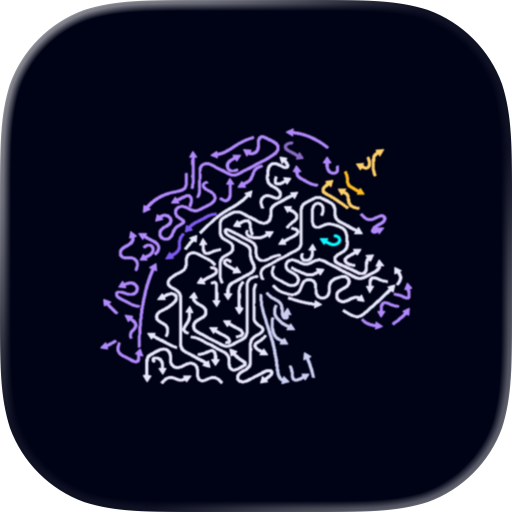
Every point on the canvas has a direction. A small arrow shows it. Place a particle anywhere and release it: the particle follows the arrow at its current position, then the arrow at its new position, then the next, continuously, without hesitation. The accumulated path — the trajectory — extends across the canvas as a glowing amber line. A gold ring pulses somewhere. The task is to find the starting point whose trajectory passes through it.
Drag the white dot. The trajectory recomputes instantly — five hundred steps of numerical integration, drawn live as the dot moves. Past trajectories linger as fading blue trails, showing every previous attempt. The blue traces accumulate as the player searches. Their shapes reveal the structure of the field: where trajectories converge, where they veer apart, where they spiral inward, where they orbit indefinitely.
The first field has two attractors separated by a saddle point. Trajectories starting on the left spiral into the left attractor. Trajectories starting on the right spiral into the right. The gold target sits in the right basin. The player begins on the left. Moving the start point toward the saddle and across it produces a sudden qualitative change — the trajectory that had been spiralling left now spirals right, approaches the target, passes through it. The convergence bar completes. A lock.
The sensitivity that makes crossing the saddle so dramatic — where one pixel of movement changes everything — is the mathematical phenomenon Edward Lorenz discovered in 1963 when he rounded his weather simulation's initial conditions from six decimal places to three. The forecast diverged completely. He called it sensitive dependence on initial conditions. It is now called the butterfly effect. The game makes it physical: the player's finger is the butterfly.
The second field has a limit cycle — a closed orbit that all trajectories approach regardless of where they start. Inside it, trajectories spiral outward. Outside, they spiral inward. Every starting point converges to the same circle, but each arrives at a different point on that circle. The target sits on the circle. The player must find the starting point whose spiral phase arrives exactly there.
The third field uses the Lotka-Volterra equations — the mathematical model of predator and prey populations. Here trajectories do not decay. They orbit indefinitely at the energy level of their starting point. The target is on one specific orbit. Too close to the fixed point and the orbit is too small. Too far and it passes above. The player adjusts the starting distance until the orbit threads the target exactly.
Four fields. Four types of dynamical behaviour. One mechanic: find where to begin.
Chrome-Stats does not own this Apple app. Please use these information below to contact the Apple app developer.


 English
 Español
 Français
 Português
 日本語
日本語 简体中文
简体中文 한국인
한국인


 (33)
(33)