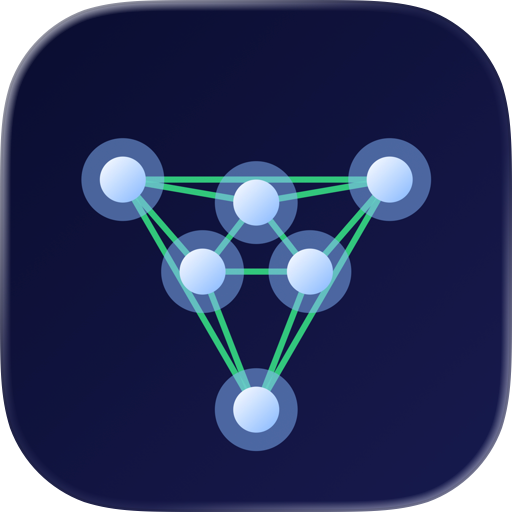
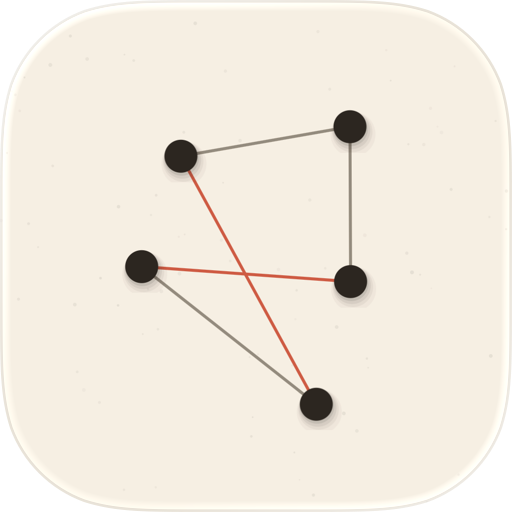
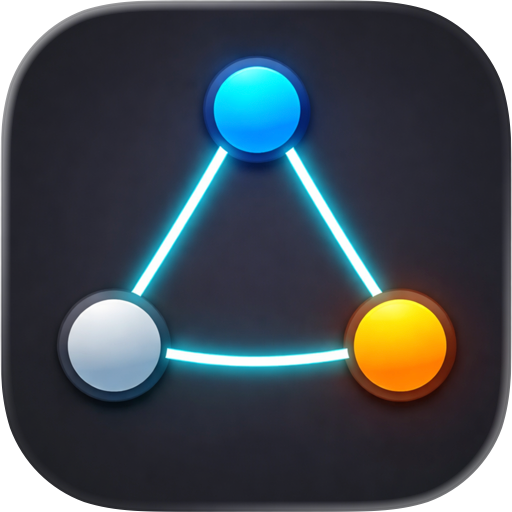
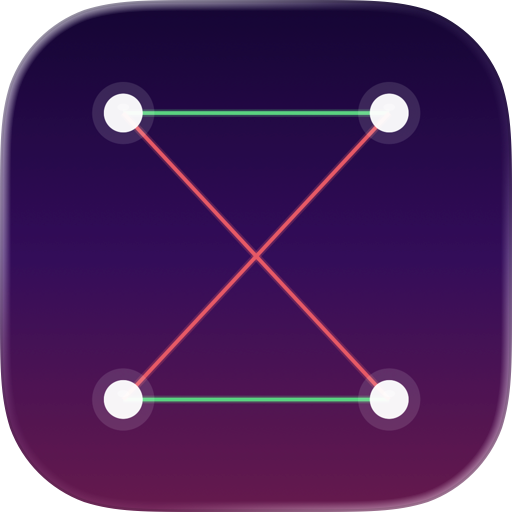
Glowing wires. Tangled nodes. Drag them apart until every wire turns green. Then one graph refuses to untangle, no matter what you try. One crossing always remains.
Node Wire Tangle gives you a tangle of glowing wires and one instruction — drag the nodes until no wires cross.
Each node is a glowing point. Each wire connects two nodes. Where wires cross, they burn red. Where they run clear, they glow green. A counter at the top shows the number of active crossings. Drag any node to reposition it. Every move instantly recomputes all crossings. Watch red wires turn green as the tangle resolves. When the counter reaches zero — every wire clear, no crossings anywhere — the graph unlocks and the next challenge assembles.
The first four graphs are planar — they can always be untangled in two dimensions. Some require patient repositioning. Some click immediately when a single node is moved to the outside of the group. Some look tangled beyond recovery until the right move reveals the clean layout underneath. Each solution is genuinely satisfying: the moment all wires simultaneously turn green is unlike any other resolution in a puzzle game.
The fifth graph is K₅.
K₅ is the complete graph on five nodes — every node connected to every other node, ten wires total. It looks like it should be untangleable. Players make progress: twelve crossings become eight, become three, become one. Then nothing works. Move a node to clear the last crossing and a new one appears somewhere else. Chase it across the canvas. It always comes back.
This is not a difficulty spike. This is mathematics. K₅ cannot be drawn on a flat surface without at least one crossing. It is non-planar. No arrangement of five nodes in a plane — any plane, any size, any configuration — can produce K₅ without a wire crossing another wire. This was proved by Kazimierz Kuratowski in 1930. The player has just discovered it through direct experience.
After a short time with one crossing remaining and no progress, the game shows a single line of text: K₅ cannot be untangled in 2D. Every graph can be untangled in 3D.
The 3D mode opens. The same five nodes and ten wires now float in a perspective three-dimensional space. One finger orbits the camera. A selected node can be lifted into the third dimension — raised above the flat plane so its wires pass over instead of through the wires remaining flat. The moment a player lifts one K₅ node and watches all four of its wires simultaneously clear — wires that seemed permanently locked in conflict simply separating because they now inhabit different layers of space — is one of the most striking moments in any puzzle game built around mathematics.
The insight that follows: in two dimensions, some graphs are permanently impossible. In three dimensions, every graph — without a single exception — can be drawn without crossings. This is why printed circuit boards use multiple layers. Each layer is a planar subgraph. The full non-planar circuit is assembled by stacking them. The player has just understood, physically, why multi-layer PCBs exist.
Later graphs introduce K₃,₃ — the other fundamental non-planar graph — and larger structures containing non-planar subgraphs in less obvious positions.
No timers. No lives. The crossing counter is the only score that matters.
Just the nodes, the wires, and the third dimension that makes everything possible.
Chrome-Stats does not own this Apple app. Please use these information below to contact the Apple app developer.

 English
 Español
 Français
 Português
 日本語
日本語 简体中文
简体中文 한국인
한국인


 (0)
(0)